








Bengaluru: A new report from the Indian Institute of Science (IISc) says the proposed short tunnel at Bengaluru’s Hebbal Junction won’t actually solve the traffic problem there. Instead, it’ll just push the congestion somewhere else.
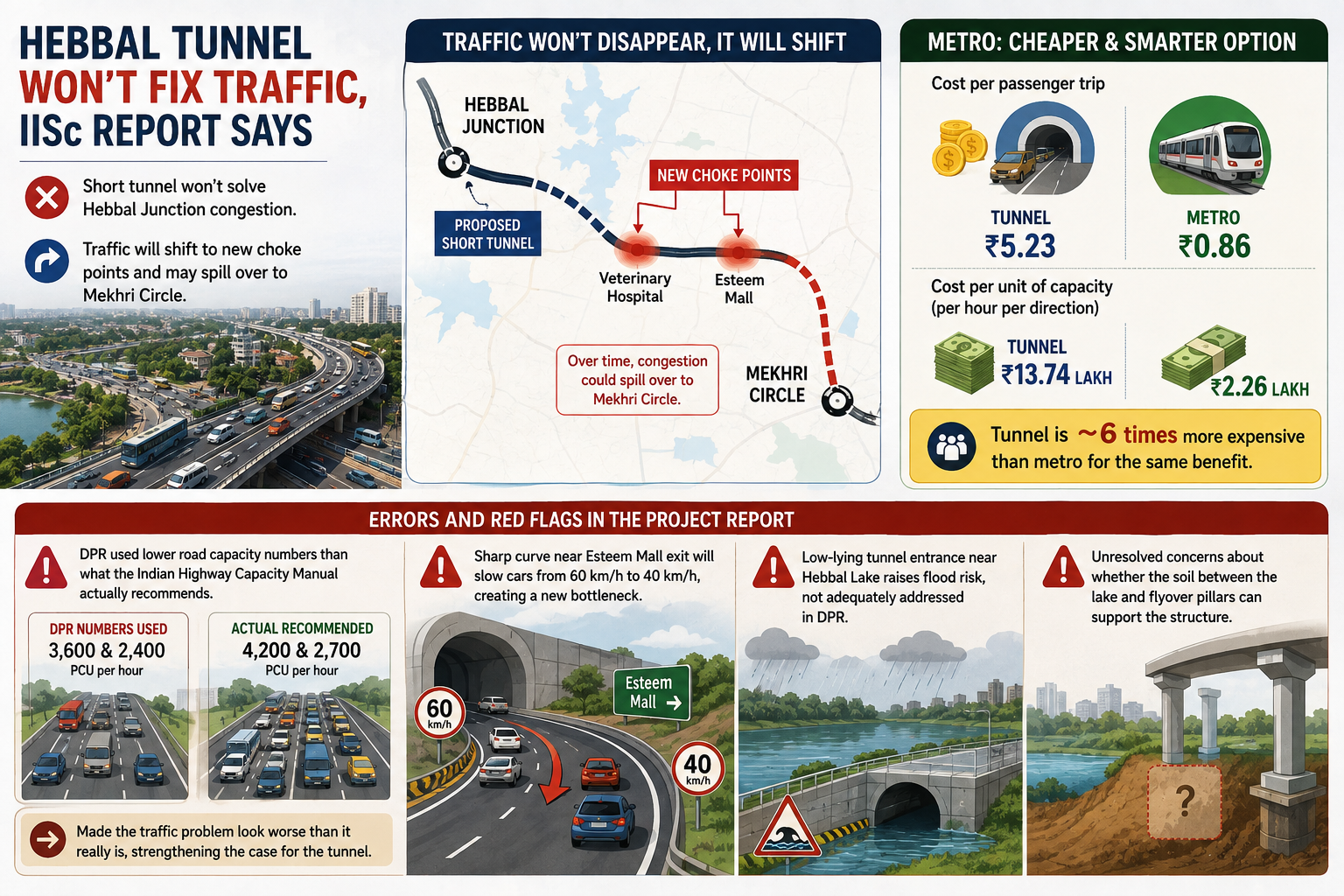
The study, done by the IISc Sustainable Transportation (IST) Lab and released on Tuesday, says the traffic jams will simply shift to new choke points near the Veterinary Hospital and Esteem Mall. Over time, the backup could even spill toward Mekhri Circle, making the tunnel practically useless.
Metro is the cheaper, smarter option
The report, authored by Professor Ashish Verma from IISc’s Department of Civil Engineering, compared the cost of the tunnel to that of an underground metro, and the numbers aren’t close.
Per passenger trip, the tunnel costs around Rs 5.23, while the metro costs just Rs 0.86. Looking at it from a capacity angle (passengers per hour per direction), the tunnel costs about Rs 13.74 lakh per unit, compared to Rs 2.26 lakh for the metro. In short, the tunnel is roughly 6 times more expensive than the metro for the same benefit, meaning taxpayers would need to spend six times as much to get a similar result.
Errors and red flags in the project report
The IST Lab also pointed out what it calls serious flaws in the tunnel project’s Detailed Project Report (DPR). It says the DPR used lower road capacity numbers (3,600 and 2,400 PCU per hour) than what the Indian Highway Capacity Manual actually recommends for those lanes (4,200 and 2,700 PCU per hour). This, the study argues, made the traffic problem look worse than it really is, building a stronger case for the tunnel than the facts support.
The report also flagged a few safety and design concerns:
– A sharp curve near the Esteem Mall exit would force cars to slow from 60 km/h to 40 km/h, which could cause its own bottleneck.
– The tunnel’s low-lying entrance near Hebbal Lake raises flood risk, something the DPR reportedly doesn’t address well.
– There are unresolved concerns about whether the soil between the lake and the existing flyover pillars can support the structure.